
How much cash does your business have sitting idle? How much is moving between accounts or waiting to settle? For many finance leaders, answering those questions requires checking balances and gathering information from several systems.
A study conducted by GatherHQ surveyed 155 senior finance decision-makers at companies with annual revenue ranging from $20 million to more than $1 billion. The findings reveal how much work can stand between having financial data and having a clear picture of a company’s money.
A clear cash picture remains elusive
When asked whether they could immediately say how much of their company’s cash was sitting in accounts earning little or no interest, just 23% said they could give the number right away. Another 53% could get close but would need to check, while 19% would have to pull information together from several places. Only 4% said they could not reliably give a figure.
For most respondents, the challenge is assembling the information needed to answer confidently. One CFO described the process:
“Cash data is stored across several separate systems. I have to manually collect and combine information from different platforms, which takes time.”
Visibility into money in transit presents a similar challenge. Only 37% reported a clear, real-time picture of funds moving between accounts, mid-payment or awaiting settlement. Most—51%—had a rough sense, while 11% knew only at certain points, such as month-end.
Those gaps can complicate decisions about when to move money, fund payments or put available cash to work. Finance teams may need to gather and verify information before they can act.
Managing the tools becomes another task
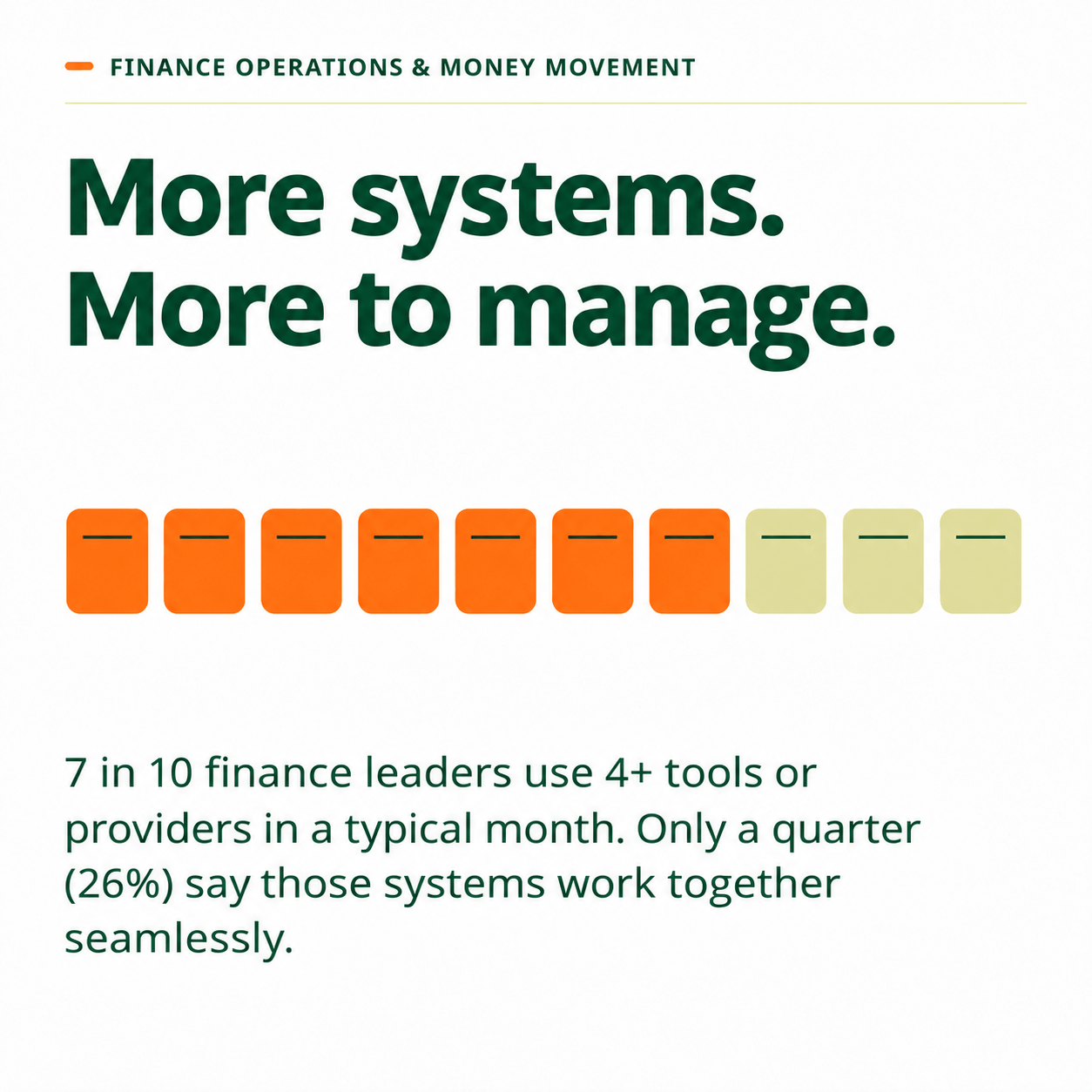
The study found that 70% of finance leaders use four or more tools or providers in a typical month, yet only a quarter (26%) say those systems work together seamlessly. Nearly two-thirds—63%—rated managing too many separate providers as a significant pain point.
Different tools can serve valuable purposes. But when teams must move information between them, reconcile records or check payment status in several places, managing those connections adds work. One head of finance operations put it this way:
“Reconciling payments across the bank, ERP, and AP platform eats up too much time. Cash visibility is scattered. I want one clear picture.”
Where finance teams can reduce manual work
For finance leaders assessing their own operations, a useful starting point is a question the team answers regularly, such as: How much cash is available? Has a payment settled? Which transactions still need to be reconciled?
Review how the team gets that answer, considering:
- How many systems does someone need to check?
- Where must information be copied, combined or reconciled manually?
- How current is the information when the answer is ready?
- Which exceptions require follow-up with another team or provider?
That review can help identify where better connections between systems could reduce effort and improve visibility. It also gives the team specific requirements to use when evaluating a change.
When evaluating payments, banking or accounts-payable providers, ask them to demonstrate how they would handle those tasks, including exceptions and the connections to existing systems. Request a financial case with clear assumptions and examples from comparable businesses. In the study, 52% of respondents ranked ROI or cost-savings figures among their three most trusted forms of evidence, and 47% included case studies from similar companies.
The goal is a finance operation in which getting a reliable view of the company’s money takes less effort—and leaves more time to decide what to do with it.
Read the full Finance Operations & Money Movement Study for more findings and perspectives from finance leaders.
About the research
The Finance Operations & Money Movement Study surveyed 155 senior finance decision-makers, with responses collected Sept. 29 to Oct. 8, 2026. Respondents include CFOs, finance heads, treasury leaders, controllers and heads of finance operations at companies with annual revenue ranging from $20 million to more than $1 billion. Every respondent plays a role in selecting payments, banking or accounts-payable providers. GatherHQ conducted the study on behalf of Priority Commerce. Results are unweighted.